in search of wisdom
October 27, 2012
Note: Click on any of the titles at top to go to that section

Arctostaphylos uva ursi
Common name: Bearberry
Single blossom ca. 3/16th inch diameter
Family Standards
1 November, 2012
In the Education Manifesto, I emphasized the desirability – no, the absolute necessity – of strong family values for the educational success of our children. So many families are stuck in an ecosystem of poverty, low expectations, and poor performance. Unquestionably there is a correlation between economic demographics and overall outcomes in schools. A famous educator once remarked, “Give me their zip codes, and I can tell you the average educational success of their kids.” That suggests that poor children are destined to fall behind and even to failing altogether. I suppose that’s the reason we throw money at them, and yet we continue to fall further behind. There is another component to the fate of the poor, having to do with prejudice, not just racial, which is still strong in our country, but cultural as well. Thus, just her accent could keep a flower girl in London from ever rising to a better station. George Bernard Shaw eloquently dramatized this in his play “Pygmalion”:
Prof. Higgins: “You see this creature with her curbstone English:
the English that will keep her in the gutter to the end of her days.
Well, sir, in three months I could pass that girl off as a duchess
at an ambassador's garden party.”
Or perhaps more appropriately, the corresponding quote from Lerner’s musical version, “My Fair Lady”:
“Look at her, a prisoner of the gutters ……….
It's ‘aoooow’ and ‘garn’ that keep her in her place.
Not her wretched clothes and dirty face.”
Professor Higgins’ benign intervention did indeed succeed in passing Liza off as a duchess, which gives us some hope that our problems could also be solved, though over a much longer time.
And yet the experience of the children of the boat people [see ‘An Education Manifesto’ on this website] totally destroyed the idea that poverty per se is responsible for poor outcomes in school.
So what is to be done? How do we change ourselves broadly across the nation so that parents will have high expectations of their children’s performance in school and will demand high quality in the schools? The United States made extraordinary progress in public education since our founding, but now we are plagued with a decline that has already put so many of our children at a disadvantage when compared to others around the globe. I see children of all income levels, but of course many more who are poor, everywhere with huge potential, largely wasted. What an enormous tragedy. There must be a way out, and my hunch is that it won’t cost much.
Let me start by giving a glimpse of what a model family might look like. I have to use our own family because it’s the only one with which I have deep knowledge. Please indulge me, as I am sure to brag a bit.
Our Own Family Experience
I had been raised by a strict Victorian/Presbyterian father and a loving Methodist mother. Mother always deferred to Father on disciplinary matters when he was around. My father was somewhat distant, both figuratively and physically, being in China and Korea, during and after two wars, for much of my life in the U.S. I wanted a much warmer, closer and more loving family environment for my kids. Reta was already on board. I wanted them to be athletic, esthetic, ethical, and pursuing whatever (good) turned them on. They were to understand, without my having to tell them, that their parents’ love was absolutely unconditional. There was never to be any question in their minds that love ever would be withdrawn when they were ill behaved, in spite of appearances on occasion to the contrary. At the same time there would be lots of discipline because they had to learn its value and uses as they came to maturity.
There were rules, just as there had been in my father’s family, but those Victorian rules that I thought were silly were discarded. Eating one’s soup by tilting the bowl away from one’s self, and spooning it in a motion away from you; or observing the Sabbath by a whole series of prohibitions, e.g. no going to movies, no playing cards, and no reading the newspaper comics section, didn’t make sense. Also, what rules I did insist upon, like a one-hour limit on TV and not interrupting another person in conversation, were applied generally with a light touch. The basic idea in interpersonal relations was very simply the Golden Rule: do unto others as you would have them do unto you. Violations could meet with punishments – corporal or otherwise. Of course these were applied more to our first born, David, as we parents were inexperienced. Fewer disciplinary actions were taken with Doug, two years younger. And by the time we got to Chris seven years later, we were so relaxed that he suffered almost no punishments at all, to the great consternation of his two older brothers.
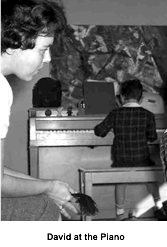
I had taken music lessons, both piano and guitar, when I was a child, but the parents worried about the expense, and seemed not to mind when the going got tough and I wanted to quit. So I never became accomplished on an instrument to my regret in later life. I didn’t want that to happen to my kids. Again, Reta was already there, being a good flutist for many years, and having played in a number of bands and orchestras. She made sure that each child had music lessons, driving them many miles to and fro every weekend, and making sure they practiced. This had the desired effect, which was reflected in a letter I wrote to the kids’ grandmother in 1975:
“I am being entertained by a musical ensemble while writing this: Reta is playing the flute, Douglas, the viola, David, the [electronic] synthesizer, and Chris is playing the drum. They have been doing some Bach, ‘Fiddler on the Roof’ and some spirituals. It is a great joy to listen to them, and to know that it has come about solely on their own volition – just for their pure enjoyment.”
So today they are all musical, although it’s David who comes home every evening and sits down at the keyboard for an hour of relaxation. And Doug has become involved in directing operas with major companies around the world.
The musical genes now have been passed on to the granddaughters, Aurora and Lyla, both of whom play the piano and are taking ballet, and one – Lyla, Chris’ daughter, currently aged 13 – who also plays the ‘cello, and who is a member with three friends of the Borealis Quartet (a name she chose).
In raising all three of our children, whenever there was 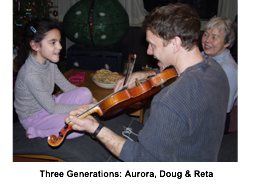 a cough, a sore, an oozing of some body fluid, we ran to Doctor Benjamin Spock – that is, to his book entitled ‘Baby and Child Care’. He was a genius in guiding an average pair of parents to the right diagnosis and appropriate treatment. His book was in two parts, the medical and the psychological/ disciplinary parts. On the latter we were in almost total disagreement.
Additionally, I always read to the kids whenever I was home in the evenings. We’d all cozy up together on the sofa, so that there was a sense of physical warmth along with the intellectual.
All of this seems to have added up to some success. No doubt the boys had personal demons to overcome as they grew up, but they did overcome them, and they pursued their dreams with relatively light regard for financial gain. David is now Professor of Biology at New York University, teaching classes, and with a research team, publishing in major scientific journals, and traveling a great deal to present papers, give lectures and attend meetings. Doug, along with his culinary colleague Mimi Oka, has published a bilingual book entitled Festins Orphiques/Orphic Fodder that is an accounting of a series of food events around the world and dissertations on the philosophy and artistic considerations of each. And as mentioned above, Doug has directed operas in Santa Fe, Los Angeles, New York, France and Chile with major orchestras, such as the NY Philharmonic and the Los Angeles Philharmonic. He has had his artwork shown in Germany, France, Greece etc. Chris has chosen to become an inventor of many diverse things, from beautiful light fixtures to medical dressings, and moving – kinetic - works of art. He has been in shows in New Mexico (where the local art critic compared him to Leonardo da Vinci, no less!) and several other states.
More on Family Values.
Tuesday, May 21, 2013
I have suggested earlier that Asians appear to be in possession of cultural values that lead to excellence in academic accomplishments if not in other aspects of life*. It’s likely that these derive from the teachings of Confucius – having passed the test of some 2,000 years of time -- in spite of vigorous attempts to eradicate them by the Communists.
Recently the American Chemical Society (ACS) announced the names of the finalists in the U.S. National Chemistry Olympiad. Here are the top 20 and their ACS affiliations:
“The 20 finalists - 16 boys and 4 girls, representing 15 ACS local sections and 10 states, are:
Matthew Adrianowycz, Brecksville-Broadview Heights High School, OH; Cleveland Section
Saaket Agrawal, Mira Loma High School, CA; Sacramento Section
Kevin Gao, Los Alamos High School, NM; Central New Mexico Section
Brandon Kao*, Valencia High School, CA; Orange County Section
Robert Kao, Edwin O. Smith High School, CT; Connecticut Valley Section
Sophia Lai, Troy High School, MI; Detroit Section
Stephen Li, Troy High School, MI; Detroit Section
David Liang*, Carmel High School, IN; Indiana Section
Runpeng Liu*, Ladue Horton Watkins High School, MO; St. Louis Section
Alexander Nie*, Livingston High School, NJ; North Jersey Section
Eric Schneider, High Technology High School, NJ; Monmouth County Section
Kalki Seksaria*, Thomas Jefferson High School for Science and Technology, VA; Chemical Society of Washington
Jingwei Shi, Canyon Crest Academy, CA; San Diego Section
Stephen Tang*, Solon High School, OH; Cleveland Section
Stephen Ting*, Monta Vista High School, CA; Santa Clara Valley Section
Derek Wang, North Allegheny Senior High School, PA; Pittsburgh Section
Jessica Xu*, Watchung Hills Regional High School, NJ; North Jersey Section
Suna Zekioglu, North Hollywood High School, CA; Southern California Section
Aaron Zeng, Detroit Country Day School, MI; Detroit Section
Grace Zhang*, East Brunswick High School, NJ; North Jersey Section
* Students who participated in 2012 USNCO Study Camp”
Of the twenty, fifteen have Chinese surnames. This is not just a statistical fluke. Fareed Zakaria in the April 15 issue of Time magazine notes that,
“Caltech and the University of California at Berkeley are now about 40% Asian. New York City’s Stuyvesant High School admits about a 1,000 students out of the 30,000 who take the Math and Reading test (and thus is twice as selective as Harvard). It is now 72% Asian-American.”
Zakaria also points out that,
“A 2009 study reports that Asian-Americans need SAT scores 140 points higher than those of white students to have the same chance at admission to elite private universities.”
So even with that hurdle placed in their path, they excel.
Do you think we should take a look at how they do it?
*Note: if you haven’t yet read about the Asian boat people, go to my Education Manifesto by clicking on that section at the top of this page.
Comments
11/2/12
What a great article to read!
There has only been one article in the NYTimes recently (that i remember) that even suggests that government may actually be important for jobs--e.g., not only directly, but also by supporting education.
Thanks!
- Dr. David Fitch, Dean of Arts & Sciences, NY University Shanghai
11/2/12
I know I shouldn't be cynical, but here in Cambridge, we spend $26,000 a year on each student, with poor results to show for it. It seems to me we are constantly shuffling the deck chairs on the Titanic to see if that will fix the problem. Years ago, we merged Cambridge High and Latin School with Rindge Technical School, and, more recently, we got rid of advanced placement courses, all in the interest of equality. Does equality of access improve quality of outcomes? The focus now is on something called the Innovation Agenda (see: http://www3.cpsd.us/ia2/ia). Will that make a difference?
- John T. Fitch, Cambridge, MA
Response:
Yes, having looked at the the Cambridge Schools site that you refer to, I too get the feeling they’re shuffling the deck chairs, and at a huge cost. Rearranging school sites, and providing shining new spaces are all well and good, but I keep harping on the fact that we are still treating the symptoms (throwing money at schools) instead of the disease (dysfunctional families). At least Cambridge recognizes that parents must be involved, but like Head Start, are they getting at the fundamental family values? I wish.
Here’s a great quote from today’s NY Times: “Leon Botstein, president of Bard College, himself a conductor and a former wunderkind, remarked dryly, “If Beethoven were sent to nursery school today, they would medicate him, and he would be a postal clerk.” [http://www.nytimes.com/2012/11/04/magazine/how-do-you-raise-a-prodigy.html?hpw&_r=0&pagewanted=print]
11/4/12
I enjoy reading your blog. It's good that you are sharing your thoughts about the future of this country. You are absolutely right about Education and family values. Cheong [her husband – Ed.] and I were brought up by parents without much education. They trusted that education was the best thing that they could give to their kids. Luckily, attending school did not cost much in Asia then.
At work, people talk about their children all the time. All want their kids to succeed. Many are devoted parents. They worry when their kids are not doing well at school. When a first grader fails a spelling test or a third grader fails the math test.
By the way, as I compare education of my kids vs. my nieces in Taiwan, I think that the US has a better system; perhaps that’s because my kids were in good public schools. They were taught critical thinking and problem-solving, instead of memorization. My kids may not get 100% in the test, but they seem to know what they are good at and pursue their own dreams.
-
-Dr. Shu-Jan Liang, Troy, NY
11/5/12
The problems you raise are (naturally?) very similar to the ones we encounter in Israel.
On a personal level, we were very happy with the education our two grandsons received all the way from kindergarten to finishing high school. Both of them went to "The Democratic Open School" in Jaffa. The emphasis there was on creativity and on making the students appreciate the fact that in order to reach ones goals, one has to acquire many skills – theory and practice. Human relations were in the fore. My feeling is that irrespective of the school's principles and practices, its success was chiefly because of the personality, ability and idealism of its teachers. Incidentally, the founder of the school was a Weizmann Institute scientist. (He followed the example of Professor Amos De Shalit, Scientific Director of the Institute, who went to teach science in a local high school, thus prompting his colleagues to get involved in the teaching of younger people).
- Dr. Itzhak Michaeli, Tel Aviv, Israel
Response:
Michaeli is a professor at the Weizmann Institute, one of the most distinguished in the world. About Shalit: he was the founder of the Department on Nuclear Physics at the Weizmann. The De Shalit High School and two junior sister high schools in Rehovot were renamed after him.
-
■In 1974, In conjunction with the Weizmann Institute, the "Amos de-Shalit Foundation" was founded to foster an increased awareness of the important role of science amongst Israeli youth, and "Amos de-Shalit Summer School program" was launched in his name. [Wikipedia]
I recall visiting the Weizmann Institute a number of years ago, and seeing there what might be called ‘the children’s physics playground’. It had all kinds of things like a see-saw with variable seats so that kids could experience in a very physical way how a fulcrum works. They understood that their children were the future of the world, and that they deserved the very best that the nation could afford.
11/12/12
First, the background. Sonia and I were attending a fundraiser at Joe and Jill Biden's home. When it came time to leave, I found Sonia intensely involved with a woman who turned out to be head of a local charter school. She was trying to convince us that charter schools would solve the problem of "the gap". There has been a persistent gap between the classroom performance of white kids and black kids. The disparity varies from time to time and from place to place. The disparity can be measured in various ways: by fourth grade, in most schools, fewer than half of black kids are performing at grade level, while about 80% of whites are doing so. In many high schools populated largely by blacks, years go by without a single graduation!
I remarked that the origin of the gap is demographic. Given that she is involved professionally in education, she really ought to know, so I went to the Census Bureau website and got the numbers. (The current figure is 3/4 for blacks and about 40% for our population as a whole.)
Why is it so bad to have all these kids born to young, unmarried girls? Well, it's bad on two levels. On a personal level, the girls are largely doomed to poverty, as are their kids. These girls have no vision of a future, and their kids are doomed to follow the same miserable life trajectory. And miserable it is: of kids living in a household with an unrelated, adult male (mother's boyfriend), 60% (!) are abused, sexually, physically, emotionally.
On a societal level, the plague of births is dreadful, because poor mothers are too harried to be concerned about community. They don't take part in the rituals of democracy: the top socioeconomic quintile votes at twice the rate of the bottom quintile. Their kids are unlikely to perform well in school, without costly and intensive intervention. It's not an overstatement to say that the birth plague is a threat to our democracy.
Then I started wondering, what would lead communities, of whatever size, to enact measures that would change this situation? Maybe if people understood the costs of these births, they'd be willing to spend something to abate the problem. [my emphasis – Ed] I found that there is an organization called National Campaign Against Teen Pregnancy, or some such, in DC. They told me that very little had been done to measure the costs, but they did refer me to one study, in SC, where the cost was estimated at $200M/yr. Starting with their list of cost categories, I went to work in Delaware.
After pre-natal care and cost of delivery (largely financed by Medicaid), there are subsidies of nutrition and housing. There are disproportionate expenditures in the criminal justice system and in foster care, etc. Given the fact that a young, unmarried mother is unlikely to finish even high school, not to mention post-secondary education, she is unlikely ever to have a substantial job, and hence unlikely ever to pay taxes; this loss of revenue is likely to be larger than the other cost categories.
We turned to medical costs. I got some funding. We found a really smart internist who is working in women's health in the largest (by far) hospital in Delaware. This team has put together on outstanding analysis, which has been presented to the Kids' Caucus of the Delaware General Assembly and to other interested groups. It will soon be published in a scholarly journal, and covered in Wilmington newspapers.
- Dr. Gilbert J. Sloan, Scientist, Wilmington, Delaware
Response:
Since we live in a capitalist society, any time we can put a price on something, it’s “value” can be measured. So to me, this is a very strong approach towards bringing about improvements in family values.
Bravo, Dr. Sloan!
Creativity represents a miraculous coming together of the uninhibited energy of the child with its apparent opposite and enemy, the sense of order imposed on the disciplined adult intelligence.
- Norman Podhoretz